

Pack child-sized earmuffs and a set of high-fidelity earplugs before any outdoor event. That two-item combination covers the full range of venue noise levels your child will encounter, from fireworks bursts to live music sets. Check the NRR (Noise Reduction Rating, the U.S. standard) or SNR (Single Number Rating, the European equivalent) on every product label. The AAO-HNS recommends keeping sustained sound below 100 dB and limiting peak exposure for children to 120 dB. The free BANZ Protect app gives you real-time noise and UV readings so you can act before levels climb too high.
- Child-sized over-ear earmuffs: primary protection for toddlers and young children
- High-fidelity earplugs: backup option that preserves sound clarity for older kids
- Foam earplugs: compact, low-cost option for very loud, short-duration events
- BANZ Protect app: free real-time monitoring for noise and UV at any venue
Table of Contents
- What to pack for your child at any outdoor event
- Which types of hearing protection work best for kids?
- How do you read NRR and SNR ratings for kids’ gear?
- What to expect at common outdoor venues
- How to fit, clean, and store kids’ hearing protection
- Pairing hearing protection with sun safety at outdoor events
- BANZ resources parents can use right now
- Key Takeaways
- Why fit beats ratings every time
- BANZ gear and resources for parents who want a ready-made solution
- Useful sources
What to pack for your child at any outdoor event
A short checklist keeps packing fast and consistent across concerts, fairs, fireworks, and sporting events.
Hearing protection
- Child-sized earmuffs (available in budget, mid-range, and premium options)
- High-fidelity earplugs with swappable filters available at various price points
- Foam earplugs as backup available inexpensively in multipacks
Sun safety
- Wide-brim hat with UPF rating or a kids’ sun hat with UPF 50+ fabric
- Sunscreen SPF 30 or higher (apply 15 minutes before going outside)
- Sunglasses with UV400 or 100% UV protection
- Lightweight UPF 50+ shirt or coverup
- Reusable water bottle
Pro Tip: Store two foam earplugs in a small zip-lock bag inside your wallet or a front pocket of your bag. They survive heat, stay clean, and are always there when the main earmuffs are in the stroller.
For travel hygiene, keep reusable silicone plugs in their original case or a small hard-shell case. Loose plugs collect lint and debris quickly, which affects both fit and attenuation.
Which types of hearing protection work best for kids?
The right choice depends on your child’s age, the event type, and how long you plan to stay.
Over-ear earmuffs deliver the highest attenuation and the easiest fit for toddlers. No insertion required, no coaching needed. The trade-off: they run warm in summer heat and can conflict with wide-brim hats. They are the go-to for fireworks, air shows, and any short, very loud burst. BANZ offers child-sized earmuffs built specifically for smaller heads and lower clamping pressure.
High-fidelity (musician-style) earplugs reduce volume evenly across frequencies so music clarity stays intact, typically offering 12–24 dB of attenuation depending on the filter. Older children who resist bulky earmuffs often accept these because sound quality remains natural. Some models include swappable filters at various attenuation levels so you can match attenuation to the venue.
Foam earplugs cost almost nothing and compress small enough to fit in any pocket. They attenuate more aggressively than high-fidelity plugs, but they muffle sound noticeably. Fit is also harder to achieve in small ear canals, which reduces real-world protection.
Custom or semi-custom options suit children with sensory sensitivities or frequent concertgoers. Cost runs higher, typically $100–$300 for custom-molded devices, but the fit is precise and the comfort is consistent. For children with autism or sensory processing differences, BANZ offers sensory-friendly earmuff options designed with lower clamping force.
Select by environment, not by the highest NRR number. A fireworks show calls for maximum attenuation from earmuffs. An acoustic outdoor concert calls for high-fidelity plugs that let your child hear the music clearly while still cutting dangerous peaks. Chasing the highest-rated number for every situation leads to over-protection that children resist wearing.
Pro Tip: For events that mix loud and quiet phases (county fairs, parades), bring both earmuffs and high-fidelity plugs. Use earmuffs near the stage or during the fireworks finale, then switch to plugs for the walk-around portions.
How do you read NRR and SNR ratings for kids’ gear?
NRR and SNR are laboratory measurements, not real-world guarantees. Manufacturers and safety experts recommend reducing the labeled NRR by roughly 50% to estimate realistic protection when no fit testing is available. A product labeled NRR 29 dB delivers closer to 14–15 dB of actual attenuation in everyday use.
| Rating | What it measures | Real-world rule of thumb |
|---|---|---|
| NRR | U.S. EPA standard, single-number dB reduction | Divide by 2 for a realistic estimate |
| SNR | European standard, similar single-number format | Subtract 4 dB for a conservative estimate |
| Attenuation at fit | Actual reduction achieved with correct fit | Only measurable via fit testing |
Fit checks every parent can do:
- Earmuffs: Press the cups gently against your child’s ears. The cushion should form a complete seal with no gap at the hairline or around glasses frames. Ask your child if they can hear you speaking at a normal volume from 3 feet away. If yes, the seal may be incomplete.
- Foam plugs: Roll the plug into a thin cylinder, insert gently, and hold for 20–30 seconds while it expands. The plug should sit flush or slightly recessed, not protruding.
- First-minute check: Watch your child’s reaction in the first minute of wear. Tugging, wincing, or immediate removal signals a fit or comfort problem.
Cleaning and replacement: Wipe earmuff cushions with a damp cloth after each use. Rinse reusable silicone plugs with warm soapy water and let them air dry. Replace earmuff cushions when the foam compresses visibly or the cushion cracks. Retire foam plugs after a single use or when they no longer spring back to full size.
Pro Tip: Test the fit at home before the event. A noisy living room or a short video at high volume gives your child a chance to adjust without the distraction of a crowd.
What to expect at common outdoor venues
Most venues do not supply hearing protection at the door. Plan to bring your own. Sound levels vary significantly by location within a venue: front-of-stage zones can reach very high sound levels while rear concourse areas are considerably quieter.
| Venue type | Typical peak levels | Venue-supplied protection | Quiet zones |
|---|---|---|---|
| Outdoor concert | 100–120 dB near stage | Rarely | Occasionally, check event site |
| Fireworks show | — | Almost never | Yes, often a designated family area |
| County fair | — | Rarely | Yes, food/rest areas |
| Sporting event | — | Rarely | Sometimes family sections |
| Parade | — | No | Move to side streets |
Questions to ask event staff or the event website before you go:
- Are earplugs or earmuffs available at the venue?
- Is there a designated quiet zone or family rest area?
- Where is the first-aid station?
- Are there sound-level monitoring signs posted?
- Can families with young children access lower-volume seating areas?
Advocacy tips: If a venue lacks hearing protection or quiet zones, ask a staff member or guest services desk directly. The AAO-HNS position supports venues providing personal hearing protection and posting safe-listening information. Referencing that guidance politely carries weight. When levels feel too high, move toward the rear or a side area rather than waiting for discomfort to signal a problem.
How to fit, clean, and store kids’ hearing protection
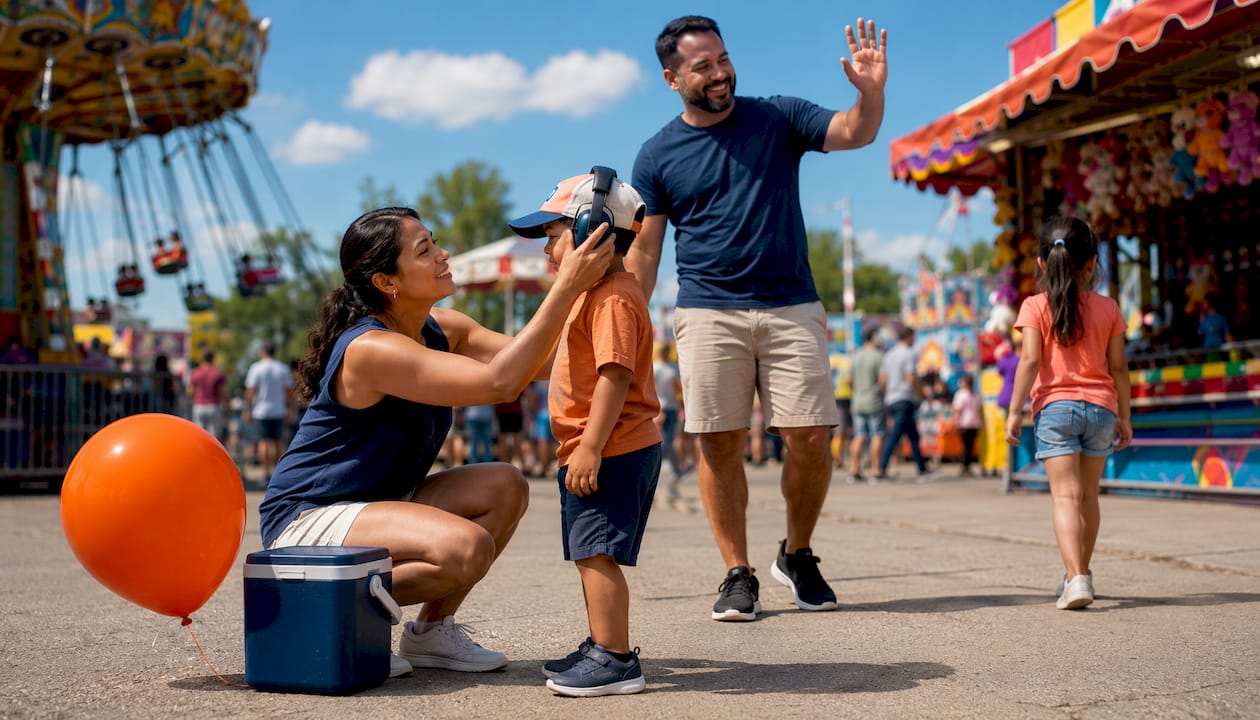
Fitting steps for earmuffs:
- Adjust the headband so cups sit centered over each ear.
- Check the seal by pressing gently and listening for a change in ambient sound.
- Confirm the headband tension is snug but not tight enough to cause pressure marks.
Fitting steps for foam plugs:
- Roll into a thin cylinder with clean, dry hands.
- Gently pull the outer ear back and up to straighten the canal.
- Insert and hold for 20–30 seconds.
Fitting steps for silicone/high-fidelity plugs:
- Insert the tip into the canal with a gentle twisting motion.
- The stem should sit flush against the outer ear.
- Check that the acoustic filter is seated correctly before use.
Storage: Keep earmuffs in a mesh bag or their original box to prevent cushion compression. Store silicone plugs in a hard-shell case. Label each child’s case if multiple kids share a bag.
Pro Tip: Pack a small resealable bag with two backup foam plugs and a travel-size pack of alcohol wipes. If a silicone plug falls on the ground, wipe it before reinserting.
Pairing hearing protection with sun safety at outdoor events
Over-ear earmuffs and wide-brim hats can conflict. The hat brim pushes the headband forward, breaking the earmuff seal. Two practical fixes: choose earmuffs with a behind-the-neck or adjustable headband, or switch to in-ear plugs when your child is wearing a brimmed hat for extended periods. In-ear options free up the head entirely for any hat style.
Recommended combos for a full-day outdoor event:
- Earmuffs + baseball-style UPF cap (lower brim, less interference) for short loud segments
- High-fidelity plugs + wide-brim UPF 50+ hat for extended outdoor time
- UPF 50+ lightweight shirt + sunscreen applied before leaving home
- UV400 sunglasses that fit under or alongside earmuff cups without breaking the seal
Apply sunscreen before putting on earmuffs. Reapplication every two hours is standard guidance. Remove earmuffs briefly, reapply to ears and neck, let it absorb for a minute, then reseat the earmuffs and check the seal again.
Pro Tip: Stick-format sunscreen is easier to apply around earmuffs than lotion. No dripping, no need to remove the cups entirely.
For more on pairing both types of protection, BANZ has a dedicated resource on taking kids to concerts that covers hearing and sun safety together.
BANZ resources parents can use right now
BANZ has helped over 2 million families across six continents with hearing and sun protection products built specifically for children. The product line covers UPF 50+ clothing, child-sized earmuffs, and UV-rated sunglasses, all sized and tested for pediatric use.
Key BANZ resources:
- BANZ Protect app: Free download. Provides real-time UV index and noise level readings at your location. Use it at the venue entrance to decide whether to put earmuffs on before entering.
- Kids’ hearing safety resources: Free downloads including NIH Noisy Planet materials and the BANZ family guide.
- NRR vs. SNR explainer: BANZ maintains a dedicated page on baby hearing protection ratings that translates label numbers into practical guidance for parents.
- Clinician resources: Pediatricians and audiologists can access BANZ materials on UV and hearing protection at well-child visits.
- Sun safety resource library: EPA, CDC, and WHO guides compiled in one place, free to download.
Fit-first selection applies to every product category BANZ offers. A UPF 50+ shirt that gaps at the collar, or earmuffs that slide off a small head, deliver less protection than their ratings suggest. BANZ products are sized for children, not scaled down from adult versions.
Key Takeaways
Child-sized earmuffs paired with high-fidelity earplugs cover the full range of outdoor venue noise, and fit matters more than the NRR number on the box.
| Point | Details |
|---|---|
| Pack two types of protection | Bring earmuffs for loud bursts and high-fidelity plugs as backup for extended wear. |
| Apply the 50% NRR rule | Assume roughly half the labeled NRR in real-world use; fit testing is the only way to confirm actual attenuation. |
| Ask venues before you arrive | Most outdoor venues do not supply protection; check for quiet zones and family areas on the event website. |
| Pair sun and hearing safety | Use in-ear plugs with wide-brim UPF hats; recheck earmuff seal after sunscreen reapplication. |
| Use BANZ for monitoring and gear | The free BANZ Protect app gives real-time noise and UV readings; BANZ earmuffs and UPF clothing are sized for children. |
Why fit beats ratings every time
Parents spend a lot of time comparing NRR numbers. That instinct is understandable, but the rating on the box is a laboratory result, not a field result. A product with NRR 29 worn with a poor seal may deliver less protection than an NRR 22 product fitted correctly. The same principle applies to UPF clothing: a shirt that rides up or gaps at the neck leaves skin exposed regardless of its fabric rating.
The practical takeaway is to test fit at home, not in a parking lot with a crowd around you. Run the earmuff seal check, watch your child’s reaction, and confirm comfort before the event. That five-minute step at home is worth more than any number on a label.
Venues are slowly improving. More family-oriented events now post sound-level information and designate quiet zones, partly because of guidance from organizations like the AAO-HNS. Asking for those accommodations at the guest services desk is a reasonable request, and it signals to event organizers that parents want them.
BANZ gear and resources for parents who want a ready-made solution
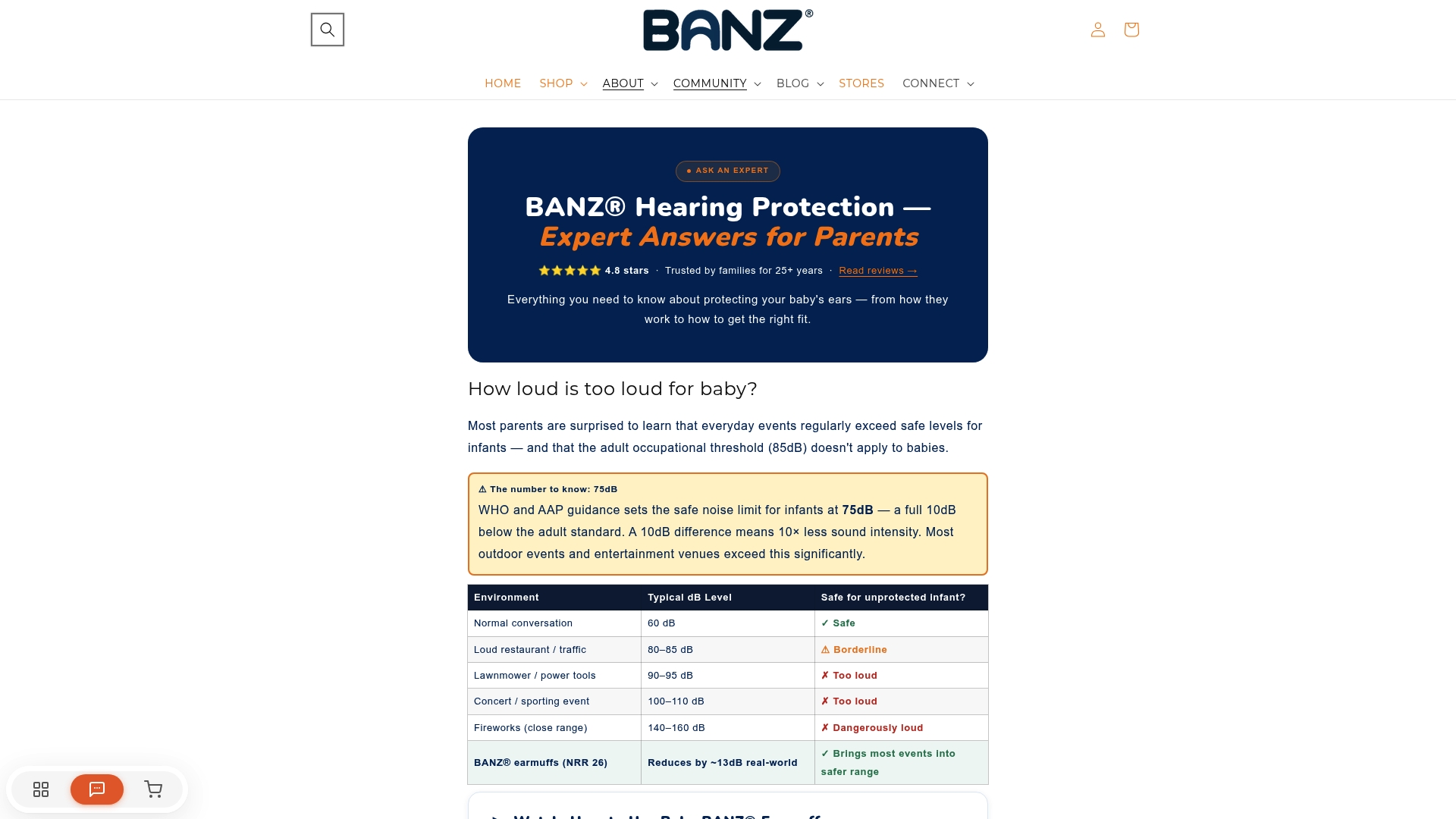
BANZ makes it straightforward to pack everything your child needs for a loud outdoor event. The kids’ earmuff collection covers infants through school age, with child-specific sizing and cushion pressure tested for comfort during extended wear. The UPF 50+ clothing line pairs directly with those earmuffs so you can check both boxes from one source.
The free BANZ Protect app is the practical addition most parents overlook. Open it at the venue gate, check the noise reading, and decide whether earmuffs go on before your child walks in. It also tracks UV index in real time, so sunscreen reapplication timing is based on actual conditions rather than a guess.
Free resources are available for parents and clinicians at the BANZ sun safety resource library, including EPA, CDC, and WHO guides you can download and share. Visit the BANZ website to browse the full product range and access the free app and resource pages.
Useful sources
Use these references to verify claims, check venue policies, and access free downloads.
- AAO-HNS: Mitigation of Noise-Induced Hearing Loss at Music Venues — authoritative venue guidance on safe sound levels, quiet zones, and hearing protection provision
- Wirecutter: Best Earplugs for Concerts — tested recommendations for high-fidelity and universal-fit earplugs
- 3M: Hearing Protection Fit and NRR Guidance — manufacturer guidance on realistic attenuation and the 50% NRR rule
- Popular Mechanics: Best Hearing Protection — practical buying guide covering comfort, heat trade-offs, and price categories
- BANZ Noise Safety for Children — everyday sound level guidance and BANZ Protect app information
- BANZ Kids’ Hearing Safety Resources — free NIH Noisy Planet downloads and family hearing-protection guides
- BANZ Sun Safety Resource Library — EPA, CDC, and WHO sun-safety guides for parents and clinicians
Check your specific venue’s website for quiet zone locations and sound-level policies before the event. Use the BANZ Protect app on-site for live readings.
Recommended
- Ear Protection in Indoor Entertainment: A Parent’s Guide – BANZ® Carewear USA
- Hearing Protection Styles for Children: 2026 Parent Guide – BANZ® Carewear USA
- Outer Ear Noise Protection for Kids at Loud Events – BANZ® Carewear USA
- Kids Noise Safety Resource Library | Hearing Protection & Sensory Support | BANZ® – BANZ® Carewear USA
