

How the UV Index helps you schedule outdoor activities safely
The UV Index tells you exactly how strong the sun’s UV radiation will be on any given day, and that number directly determines when outdoor activities are safe. Developed jointly by the National Weather Service and the EPA, it runs on a scale from 0 to 11+, with each step representing a measurable increase in skin and eye damage risk. When you check it before heading outside, you can time your plans around the safest windows of the day.
Think of it the way you use a temperature forecast. The WHO describes the UV Index-index) as a tool analogous to temperature readings, designed to guide daily protective behaviors tailored to UV intensity. You check the temperature before deciding what to wear. You check the UV Index before deciding when to go out and what protection to bring.
Here is what the index tells you at a glance:
- UV 0–2 (Low): Minimal risk. No protection required under normal conditions.
- UV 3–7 (Moderate to High): Protection needed. Seek shade during late morning through mid-afternoon. Apply broad-spectrum SPF 15+ sunscreen, wear a hat, and put on sunglasses.
- UV 8+ (Very High to Extreme): Extra protection required. Limit time outside between 10:00 AM and 4:00 PM. Sunscreen, protective clothing, a wide-brimmed hat, and UV-blocking sunglasses are all necessary.
The core scheduling rule is straightforward: protection starts at UV 3 and above. Below that threshold, most people can spend time outdoors with minimal precautions. Above it, the timing and duration of outdoor exposure require active management.
What the UV Index scale actually means for your health
The UV Index is a linear scale, which has a practical consequence most people miss. UV 12 causes skin damage-index) twice as fast as UV 6 under the same conditions. Doubling the index halves the time before harm occurs. That relationship makes the difference between a UV 6 and a UV 10 day far more significant than the numbers alone suggest.
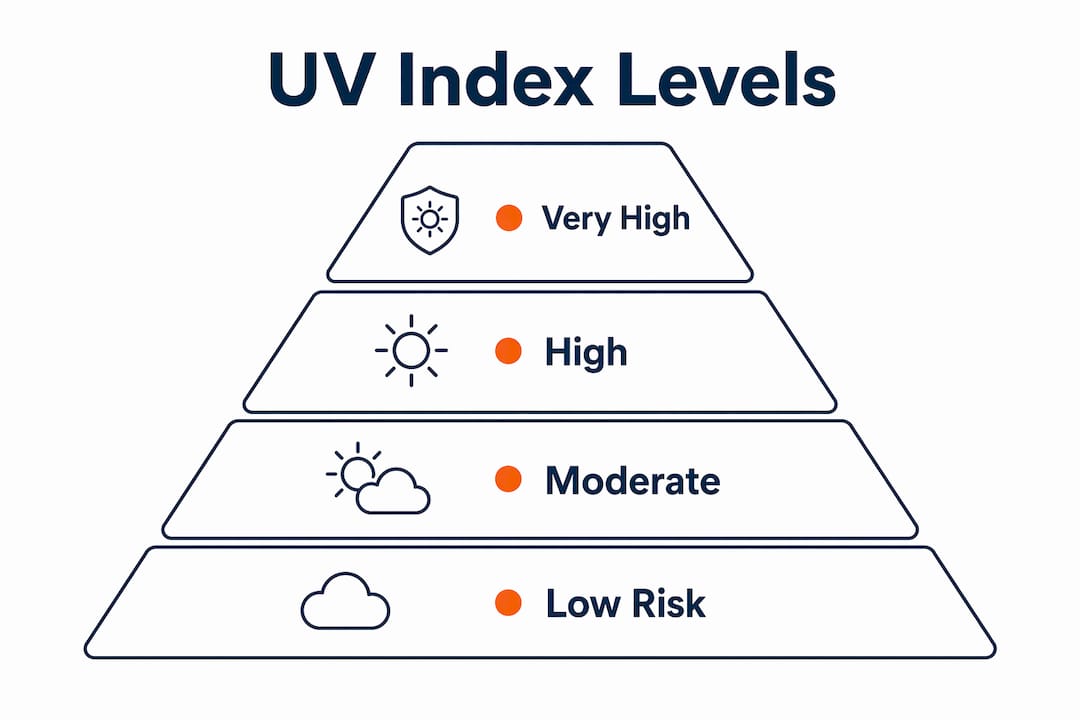
The EPA and WHO align on five risk categories. The table below maps each range to its health implications and the protection level required.
| UV Index | Risk Category | Health Implications | Protection Required |
|---|---|---|---|
| 0–2 | Low | Minimal risk for most people | None needed under normal conditions |
| 3–5 | Moderate | Increased risk with extended exposure | Shade, SPF 15+ sunscreen, hat, sunglasses |
| 6–7 | High | Skin and eye damage possible within hours | All of the above; limit midday exposure |
| 8–10 | Very High | Unprotected skin can burn quickly | Full protection; reduce time outdoors |
| 11+ | Extreme | Damage can occur in minutes | Avoid midday sun; maximum protection required |
The UV Index forecast reflects the peak expected exposure around solar noon, not an average for the whole day. The EPA publishes this forecast for most ZIP codes across the United States, calculated by the National Weather Service using ozone concentration, cloud cover, and ground elevation. A UV Alert gets issued when the index is forecast to run higher than normal for a given area, which is worth watching during summer months in high-elevation or low-latitude regions.
Overexposure to UV radiation is the most preventable risk factor in skin cancer development. Cataracts and other eye conditions are also linked to cumulative UV exposure over time. The index gives you the data to act before damage accumulates.
How time of day and environment change your actual UV exposure
Peak UV hours in the United States run from 10:00 AM to 4:00 PM during daylight saving time. That six-hour window accounts for the majority of daily UV radiation reaching the ground. Scheduling outdoor activities before 10:00 AM or after 4:00 PM cuts exposure significantly without requiring you to stay indoors all day.

Solar noon, the point when the sun sits highest in the sky, produces the most intense UV radiation of the day. Depending on your location and whether daylight saving time is in effect, solar noon falls somewhere between 12:00 PM and 2:00 PM. UV levels rise sharply in the two hours before solar noon and fall gradually in the two hours after. A run at 8:00 AM and a run at 1:00 PM on the same day can involve dramatically different UV exposure levels, even when the sky looks identical.
Environmental factors shift your personal exposure beyond what the index predicts:
- Cloud cover: Thin or scattered clouds transmit 73%–89% of UV radiation. Overcast skies still allow roughly 31% through. Clouds are not a reliable shield.
- Elevation: UV intensity increases with altitude. Higher ground means less atmosphere filtering the radiation before it reaches you.
- Reflective surfaces: Fresh snow can reflect over 80% of UV rays, nearly doubling your effective exposure. Water and light-colored sand also reflect UV significantly, which is why beach and ski days carry higher risk than the index alone suggests.
- Latitude: Locations closer to the equator receive more direct UV radiation year-round. Southern states in the U.S. consistently see higher UV Index readings than northern ones during the same season.
- Season: UV levels peak in late spring and summer. April through September is the period when protection measures matter most for most Americans.
Pro Tip: Check the UV Index for your specific ZIP code, not just a regional forecast. Elevation, local cloud patterns, and proximity to reflective surfaces like lakes or beaches can push your actual exposure well above the regional average.
Using the UV Index to plan and prepare for outdoor activities
Checking the UV Index before any outdoor plan takes about ten seconds. The EPA and NOAA both publish next-day forecasts by ZIP code. The National Weather Service UV Index page, the EPA’s Sun Safety site, and weather apps like Weather.gov all display the forecast alongside color-coded risk levels. BANZ’s free BANZ Protect app provides real-time UV monitoring directly from your location, which is useful when conditions shift mid-activity.
Scheduling based on UV means more than just avoiding noon. Here is how to build UV awareness into your outdoor planning:
- Morning scheduling: Plan high-exertion activities like running, cycling, or youth sports before 10:00 AM. UV levels are consistently lower, and the heat is more manageable.
- Afternoon windows: After 4:00 PM, UV intensity drops enough that moderate outdoor activity carries lower risk, especially on moderate-index days.
- Event planning: For outdoor events that cannot shift time slots, identify shaded areas in advance and plan rotations so participants are not in direct sun continuously.
- Worksite scheduling: The CDC recommends scheduling outdoor tasks like mowing or construction work for early morning rather than midday, and rotating workers to reduce cumulative exposure.
- School and sports programs: Schedule recess and athletic practice outside the 10:00 AM to 4:00 PM window when possible. Provide sunscreen reapplication breaks during any outdoor session that falls within peak hours.
Pro Tip: Use the Shadow Rule as a quick on-site check. When your shadow is shorter than your height, UV levels are high and immediate protection is needed. When your shadow is taller than you, UV exposure is lower. No app required.
Preparation before going out matters as much as timing. Gather sunscreen, protective clothing, hats, and sunglasses before you leave, not after you arrive. Reactive protection, applied after you notice the sun is strong, is always less effective than proactive preparation based on the forecast.
Practical sun protection matched to UV Index levels
Protection measures are not one-size-fits-all. What you need at UV 3 differs from what you need at UV 10. The EPA recommends broad-spectrum SPF 15+ starting at UV 3, with shade and physical barriers like hats and clothing added as the index climbs. At UV 8 and above, all of those measures become necessary simultaneously, not optional additions.
Sunscreen effectiveness depends entirely on correct use. Reapply every two hours, and reapply immediately after swimming or heavy sweating, regardless of the label’s stated duration. Apply to all exposed skin, including the nose, ears, and back of the neck. Use lip balm with SPF for the lips.
Here is a practical protection checklist organized by UV Index level:
- UV 0–2: No specific protection required. Sunglasses optional but useful for eye comfort.
- UV 3–5: Apply SPF 15+ broad-spectrum sunscreen to exposed skin. Wear a hat with a brim. Seek shade during the midday window. Sunglasses with UV protection recommended.
- UV 6–7: All of the above, plus wear tightly woven, long-sleeved clothing when practical. Limit continuous time in direct sun. Reapply sunscreen every two hours.
- UV 8–10: Avoid outdoor exposure between 10:00 AM and 4:00 PM when possible. If outside, wear full protective clothing, a wide-brimmed hat, and UV-blocking sunglasses. Apply SPF 15+ or higher and reapply every two hours or after water exposure.
- UV 11+: Stay out of direct sun during midday hours. Maximum protection required at all times outdoors. Shade, full coverage clothing, SPF 30+ sunscreen, and UV-rated sunglasses are all necessary.
Shade reduces UV exposure by 50% or more, but only when it is genuine overhead shade, not partial or side shade. A beach umbrella, a tree canopy, or a UV shelter tent all qualify. An open-sided tent or a wall that blocks only the direct sun angle offers less protection than the number suggests.
Clothing provides reliable, consistent protection that sunscreen cannot match for coverage. Tightly woven fabrics block UV rays more effectively than loosely knit ones. UV rays pass through the gaps in open-weave fabric, which is why a thin cotton T-shirt offers less protection than it appears to. For children especially, UV-protective clothing with a rated UPF value is worth the investment.
Special considerations for children, skin types, and medical conditions
Children require earlier and more rigorous protection than adults at every UV level. Their skin is thinner, their cumulative lifetime UV exposure is just beginning, and they typically spend more time outdoors than most adults. The UV risk for children and those with sensitive skin types means that protective measures should begin at lower UV thresholds and be applied more consistently than standard adult guidelines suggest.
Children and infants
Babies under six months should be kept out of direct sunlight entirely. For older children, apply sunscreen before going outside, not after arriving at the park or beach. Reapplication is often skipped during play, which is when exposure accumulates fastest. The CDC recommends keeping children out of direct sun from noon to 2:00 PM when possible, particularly during summer months. Hats with full brims, UV-rated sunglasses, and UPF 50+ clothing provide layered protection that does not depend on a child staying still for sunscreen application.
BANZ products are built specifically for this gap. UPF 50+ sun hats and UV-protective sunglasses designed for infants and toddlers give parents a reliable physical barrier that stays in place during active outdoor time. For families spending extended time outdoors at events, beaches, or parks, the BANZ Protect app provides real-time UV readings so caregivers can act on current conditions rather than a morning forecast that may no longer reflect the actual UV level.
Skin type and personal UV sensitivity
Skin type directly affects how quickly UV damage occurs. People with fair skin, light eyes, or a history of sunburn burn faster at any given UV Index level than those with darker skin tones. Fitzpatrick Skin Types I and II (very fair to fair skin) can experience damage at UV levels that pose minimal risk to Skin Types V and VI. That does not mean darker skin tones are immune. UV-related eye damage and long-term skin cancer risk affect all skin types, though the time to damage varies.
Anyone with a personal or family history of skin cancer, those taking photosensitizing medications (including certain antibiotics, diuretics, and retinoids), and people with conditions like lupus or albinism need to treat every UV Index level with extra caution. For these groups, protection measures appropriate for a UV 8 day may be warranted even at UV 5. Consulting a dermatologist about personal UV thresholds is the most reliable way to calibrate individual risk.
Practical steps for vulnerable groups
- Start protection earlier in the day, before UV levels reach the moderate threshold.
- Use SPF 30+ rather than the minimum SPF 15 when skin sensitivity is elevated.
- Prioritize physical barriers (clothing, hats, shade) over sunscreen alone.
- Check the UV Index daily and adjust outdoor timing accordingly, not just during summer.
- For children, UV eye protection is as important as skin protection. Cumulative UV exposure to the eyes in childhood contributes to cataract risk later in life.
BANZ’s UV safety resources include guides specifically for parents and caregivers managing UV exposure for young children, with practical tools for daily scheduling and protection decisions.
Key Takeaways
The UV Index is the most practical tool available for scheduling outdoor activities safely, and protection should begin at UV 3 regardless of how the sky looks.
| Point | Details |
|---|---|
| Protection starts at UV 3 | Apply sunscreen, wear a hat and sunglasses, and seek shade whenever the UV Index reaches 3 or above. |
| Peak UV hours are 10 AM to 4 PM | Schedule outdoor activities before 10:00 AM or after 4:00 PM to reduce UV exposure significantly. |
| Clouds do not block UV | Thin or scattered clouds transmit 73%–89% of UV radiation, so overcast conditions still require protection. |
| Shade cuts exposure by 50%+ | Genuine overhead shade from a canopy, tree, or UV shelter reduces UV exposure by 50% or more. |
| Children need earlier protection | UV risk for children and sensitive skin types requires protection measures to begin at lower UV thresholds than standard adult guidelines. |
