

TL;DR:
- Photoprotection for kids involves using sunscreen, clothing, shade, and habits to prevent UV damage. Early protection reduces the risk of skin cancer by childhood and beyond, regardless of skin tone. Layered defenses and consistent habits are essential for effective sun safety in children.
Photoprotection for kids is the practice of shielding children’s skin from ultraviolet (UV) radiation using sunscreen, protective clothing, shade, and behavioral habits to prevent sunburn and long-term skin damage. Understanding what is photoprotection for kids matters more than most parents realize: 80% of lifetime UV exposure occurs before puberty, which means the habits you build now directly shape your child’s skin health for decades. Medical guidelines recommend broad-spectrum SPF 30+ sunscreen as a baseline, but effective sun protection for children goes well beyond a single product. BANZ has spent years helping parents build complete, practical photoprotection routines that work in real life.
Why is photoprotection vital for children’s long-term health?
Children’s skin is more vulnerable to UV damage than adult skin. The outer layer is thinner, melanin production is still developing, and the DNA repair systems that fight UV-induced cell damage are not yet fully mature. Every sunburn a child receives increases the risk of melanoma later in life. That risk compounds with each repeated exposure.
UV radiation causes three types of harm: immediate sunburn, cumulative skin aging, and DNA mutations that can trigger skin cancer. Parents often focus only on preventing visible burns, but the invisible damage from UVA rays is equally serious. UVA penetrates deeper into the skin and contributes to long-term cellular damage even on cloudy days.
Children accumulate the majority of their lifetime UV dose during the first two decades of life. Protecting skin early is not optional. It is the single most effective way to reduce adult skin cancer risk.
A critical point that surprises many parents: skin tone does not eliminate the need for photoprotection. Children with darker skin tones have more natural melanin, which offers some protection, but they still accumulate UV damage and remain at risk for skin cancer and eye injury. Sun safety is universal, regardless of complexion.
What are the safest photoprotection methods by child age?
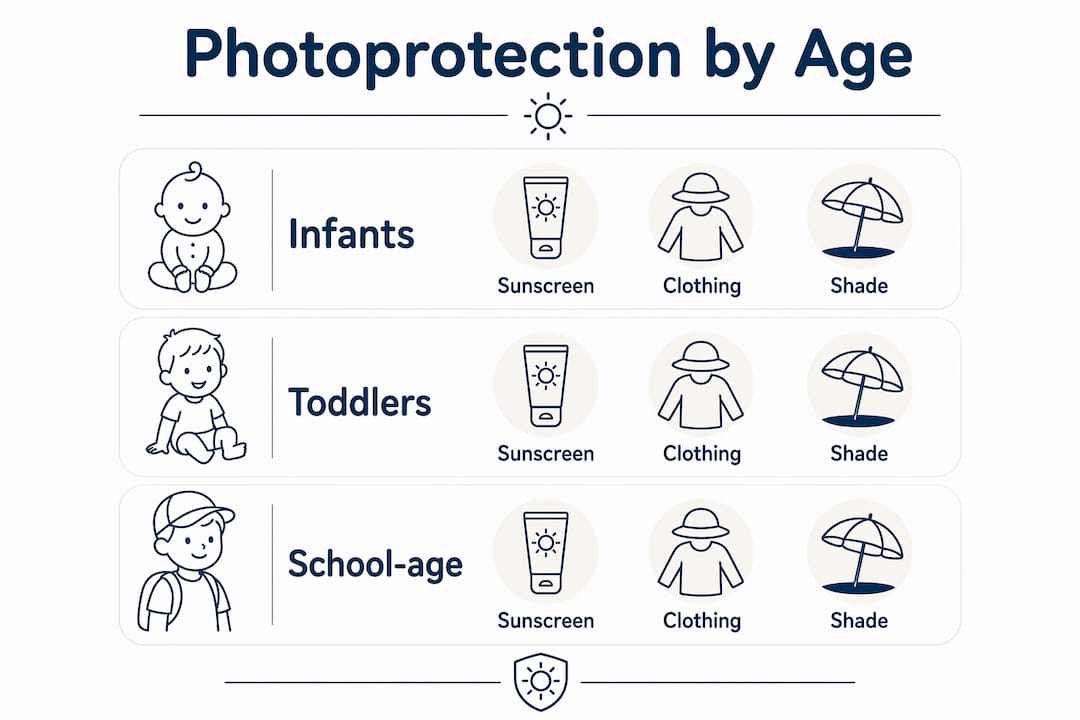
The right approach to kids’ skin care UV protection depends on age. Infants, toddlers, and school-age children each need a different strategy.
Infants under 6 months
Babies under 6 months should not be exposed to direct or indirect sunlight if it can be avoided. Their skin and metabolic systems cannot process sunscreen chemicals safely. The correct approach at this age relies entirely on physical barriers: shade, lightweight long-sleeved clothing, wide-brimmed hats, and stroller covers with UV protection. Keep outings during peak UV hours to a minimum.
Toddlers and young children
Once a child passes 6 months, mineral sunscreens become the preferred option. Physical mineral sunscreens containing zinc oxide or titanium dioxide sit on the skin’s surface rather than absorbing into it. They are less likely to cause irritation on sensitive skin and start working immediately upon application.
Key application rules for this age group:
- Choose broad-spectrum, water-resistant sunscreen with SPF 30 or higher.
- Apply 15–20 minutes before going outside so the product bonds to the skin.
- Reapply every 2 hours, or sooner if your child has been swimming or sweating heavily.
- Cover all exposed areas: face, ears, back of the neck, tops of feet, and the backs of hands.
- Avoid spray sunscreens for young children due to inhalation risks, especially for children with asthma. Cream and stick formulas are safer and easier to apply evenly.
School-age children
Older children can use a wider range of sunscreen formulas, but the SPF 30+ broad-spectrum rule still applies. At this age, teaching children to apply their own sunscreen builds a habit that sticks into adulthood. Pair sunscreen with UPF-rated clothing and wide-brimmed hats for layered protection.
Pro Tip: Keep a dedicated tube of sunscreen in your child’s school bag and one by the back door at home. Visible placement is the single biggest driver of consistent use.
How do clothing, hats, and shade support sun protection?
Sunscreen alone is not a complete photoprotection strategy. Combining sunscreen with clothing and shade produces the best results. Each layer of defense covers the gaps left by the others.
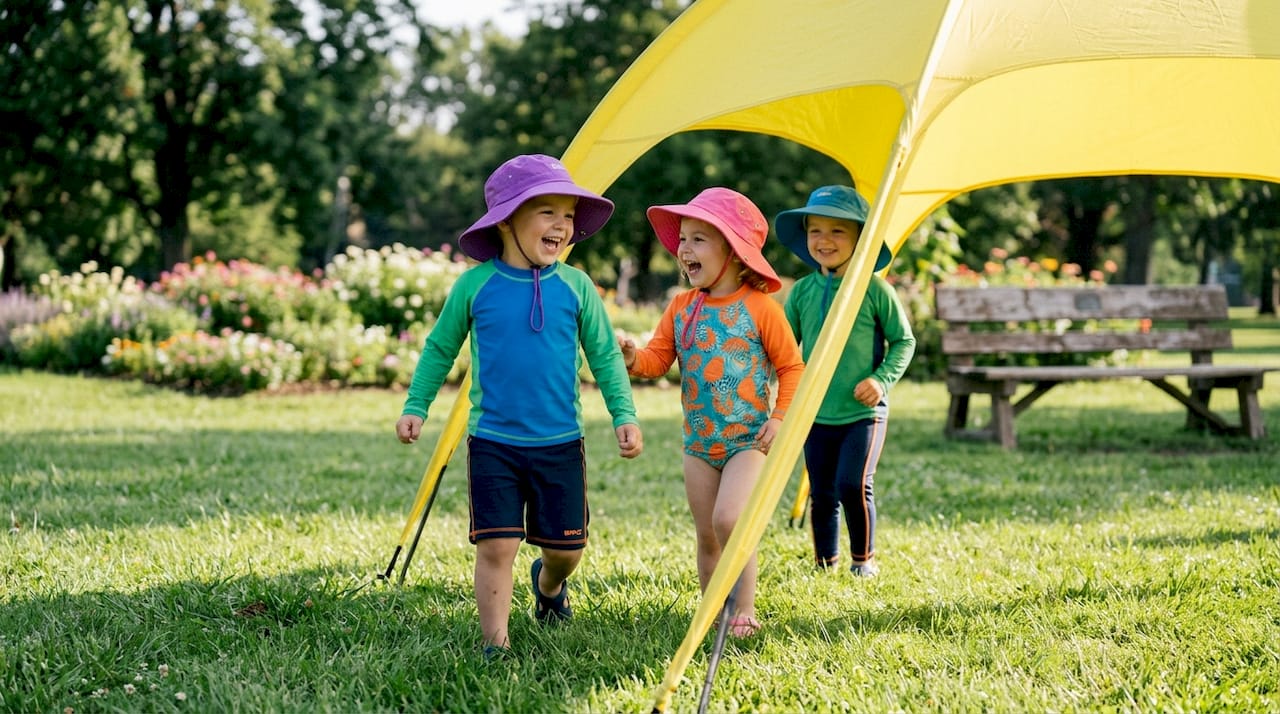
UPF (Ultraviolet Protection Factor) clothing is rated for how much UV radiation the fabric blocks. A UPF 50+ garment blocks over 98% of UV rays. Fabric weave, color, and fit all affect the rating: tightly woven, darker fabrics with a looser fit over the skin provide the most protection. Lightweight options in breathable materials make it easier for kids to wear them without complaint during warm weather.
Wide-brimmed hats protect the face, ears, and back of the neck, which are areas that sunscreen often misses or wears off quickly. A sun hat with a wide brim of at least 3 inches provides meaningful coverage for all three zones. Baseball caps leave the ears and neck exposed, making them a poor substitute.
Shade is helpful but not sufficient on its own. UV rays reflect off surfaces like water, sand, and concrete, reaching skin even when a child is sitting under a tree or umbrella. Shade reduces direct UV exposure but does not eliminate it.
| Protection method | What it covers | Key limitation |
|---|---|---|
| SPF 30+ sunscreen | Exposed skin areas | Requires reapplication every 2 hours |
| UPF 50+ clothing | Covered skin | Does not protect face or neck without a hat |
| Wide-brimmed hat | Face, ears, neck | Does not protect body or legs |
| Shade | Reduces direct UV | UV reflects off surfaces; not full protection |
Avoiding peak sun hours between 10:00 AM and 4:00 PM reduces UV intensity significantly. Scheduling outdoor play for early morning or late afternoon is one of the most effective behavioral sun protection strategies for kids.
Pro Tip: When shopping for outdoor sun safety gear, look for UPF ratings on the label, not just “sun-protective” marketing language. The UPF number is the only standardized measure.
What are common photoprotection myths parents should know?
Misinformation about sun safety leads to real gaps in protection. These are the most common misconceptions worth correcting.
- Myth: Darker skin does not need sunscreen. Melanin provides some natural UV filtering, but children of all skin tones remain vulnerable to UV damage, eye injury, and skin cancer. Photoprotection is universal.
- Myth: Sunscreen is toxic or harmful. Modern sunscreens approved by the FDA are safe for children over 6 months. Mineral formulas with zinc oxide are the most studied and have a strong safety record for sensitive skin.
- Myth: One application lasts all day. Sunscreen breaks down with sweat, water, and sun exposure. A single morning application provides no meaningful protection by midday.
- Myth: Spray sunscreens are just as safe as creams. Spray sunscreens carry inhalation risks for young children, particularly those with respiratory conditions. Cream and stick formats are the safer choice for kids under 10.
- Myth: Shade means full protection. UV rays bounce off reflective surfaces and reach skin even in the shade. Shade reduces exposure but does not replace sunscreen or protective clothing.
Understanding these myths helps parents close the gaps in their child’s sun safety routine. Layered defenses, not a single product, define effective photoprotection for children.
Key Takeaways
Effective photoprotection for kids requires layered defenses: broad-spectrum SPF 30+ sunscreen, UPF-rated clothing, wide-brimmed hats, and behavioral habits like avoiding peak sun hours.
| Point | Details |
|---|---|
| Start protection early | 80% of lifetime UV exposure happens before puberty, making early habits critical. |
| Use mineral sunscreen for young children | Zinc oxide and titanium dioxide formulas are safer and less irritating for sensitive skin. |
| Reapply sunscreen consistently | Apply 15–20 minutes before sun exposure and reapply every 2 hours or after swimming. |
| Layer physical barriers | UPF clothing and wide-brimmed hats cover areas sunscreen often misses. |
| Shade is not full protection | UV reflects off water, sand, and concrete, so always combine shade with other defenses. |
Sun safety works best when it becomes a habit
Parents often tell me the hardest part of sun protection is not knowing what to buy. It is getting kids to cooperate every single time. I have seen this play out repeatedly: parents invest in good sunscreen and the right hat, then skip both on a rushed Tuesday morning because the routine is not locked in yet.
The research is clear on this. Consistent sunscreen use, treated like brushing teeth, produces dramatically better outcomes than occasional careful application. The habit matters more than the product.
What actually works is removing friction. Put sunscreen next to the toothbrush. Keep a hat by the front door. Make it part of the “leaving the house” checklist, not a separate decision. Children who grow up with sun protection as a normal part of their routine carry that habit into adulthood, which is where the real skin cancer prevention payoff lives.
One more thing I want parents to hear: you do not need a perfect system. You need a good-enough system applied consistently. A reapplied SPF 30 cream beats a forgotten SPF 50 spray every time.
— Shari M. Murphy
BANZ sun safety resources for parents
BANZ has built a free library of sun safety resources drawn from the EPA, CDC, and WHO to help parents move from information to action.

The Kids Sun Safety Resource Library covers UV index guides, age-specific protection checklists, and product guidance for UPF clothing, sun hats, and sunscreen selection. BANZ products, trusted by over 2 million families across six continents, are designed specifically for children’s outdoor safety. The free BANZ Protect app adds real-time UV monitoring so you always know the current risk level before heading outside. For parents who want a complete picture of UV protection for kids, the resource library is the right starting point.
FAQ
What is photoprotection for kids, exactly?
Photoprotection for kids is the use of sunscreen, protective clothing, shade, and behavioral habits to shield children’s skin from UV radiation. The goal is to prevent sunburn, premature skin aging, and long-term skin cancer risk.
At what age can children start using sunscreen?
Children under 6 months should avoid sunscreen and rely on shade and clothing instead. From 6 months onward, broad-spectrum mineral sunscreen with SPF 30 or higher is recommended.
How often should I reapply sunscreen on my child?
Reapply every 2 hours during outdoor activity, or sooner if your child has been swimming or sweating. A single morning application does not last the full day.
Does my child need sunscreen if they have darker skin?
Yes. Children with darker skin tones have more natural melanin but still accumulate UV damage and face skin cancer risk. Photoprotection is recommended for all skin tones.
Are spray sunscreens safe for children?
Spray sunscreens carry inhalation risks, particularly for children with asthma or other respiratory conditions. Cream and stick formulas are the safer and more reliable choice for kids.
Recommended
- UV Radiation and Children’s Skin Damage: A Parent’s Guide – BANZ® Carewear USA
- UV Protect Your Kids: A Parent’s Complete 2026 Guide – BANZ® Carewear USA
- How UV Exposure Affects Toddler Eyes: A Parent’s Guide – BANZ® Carewear USA
- Types of UV Radiation: Children’s Sun Safety Guide – BANZ® Carewear USA