

TL;DR:
- A sun-safe school environment combines policies, shade infrastructure, and education to effectively reduce UV exposure. Implementing and maintaining these elements creates a culture that promotes long-term sun protection habits among students.
A sun-safe school environment is defined as a setting where written policies, physical shade structures, and behavioral education work together to reduce students’ cumulative UV exposure during school hours. Most skin damage from UV radiation begins in childhood, making schools a critical point of intervention. The CDC identifies a UV index of 3 or higher as the threshold requiring protective action. Understanding what is a sun safe environment in schools gives parents and educators a clear framework for protecting children every single day.
What is a sun safe environment in schools?
A sun-safe school environment combines three layers of protection: formal policy, physical infrastructure, and active education. No single layer works alone. A school with shade structures but no dress code still leaves children exposed. A school with a written policy but no staff enforcement sees that policy ignored within weeks.
The recognized industry term for this approach is a “SunSmart school,” a standard developed and promoted by Cancer Council Australia and adopted internationally. The SunSmart framework requires schools to address sun protection across all three layers simultaneously. Australian primary schools with formal SunSmart membership implement sun protection more consistently than schools relying on informal practices. That gap in outcomes shows why formal adoption matters.
Peak UV hours run from 10:00 AM to 4:00 PM in most regions. Schools that schedule recess and outdoor physical education outside these windows reduce UV exposure without spending a dollar on infrastructure. That scheduling adjustment is one of the most underused tools in sun safety planning.
What policies and practices define a sun-safe school?
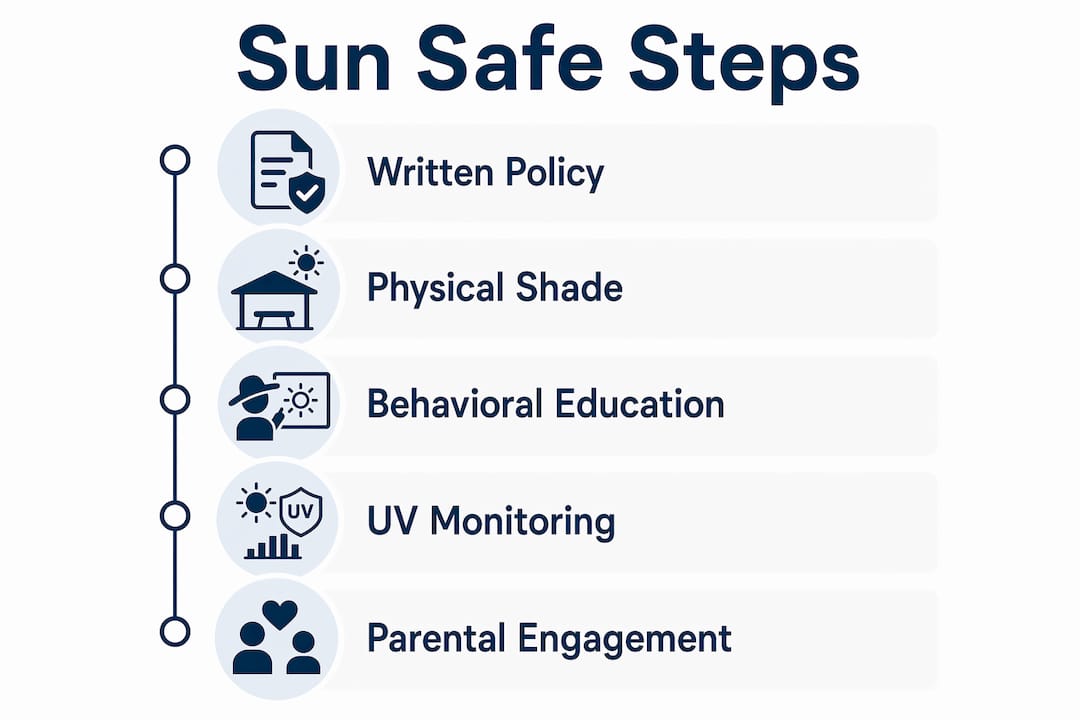
A written sun protection policy is the foundation of every effective sun-safe school. Without a documented policy, sun safety depends entirely on individual staff decisions, which vary from teacher to teacher and day to day.
Strong school sun safety guidelines cover these core areas:
- Dress code requirements: Uniforms or daily clothing must include wide-brimmed hats for all outdoor activities. UPF-rated, densely woven clothing and mandatory hats enforce protective behaviors within the school’s duty of care.
- Sunscreen protocols: Schools should require broad-spectrum SPF 30+ sunscreen applied 15–30 minutes before outdoor activity, with reapplication every 2 hours. Mineral sunscreens are preferred for children with sensitive skin.
- UV risk triggers: The CDC recommends that a UV index of 8 or higher requires avoiding direct sunlight entirely and increasing sunscreen reapplication frequency. Schools should build this threshold into their daily decision-making.
- Staff modeling: Teachers and aides who wear hats and apply sunscreen visibly reinforce the behavior they expect from students. Role modeling is a documented driver of compliance in school health programs.
- Policy review cycles: Sun protection policies need annual review with input from parents, staff, and school health advisors to stay current with updated guidelines.
Pro Tip: Post the daily UV index on a visible board near the main entrance each morning. Students and staff who see the number take protective action more consistently than those relying on memory alone.
Engaging parents in policy development increases buy-in at home. When families understand the school’s sun protection standards, they send children prepared with hats, sunscreen, and appropriate clothing. A school sun protection policy that includes a parent communication component closes the gap between school rules and home habits.
How do environmental changes create safer outdoor spaces?
Physical modifications to school grounds are the most durable form of sun protection. Policies can be ignored. Shade structures cannot.
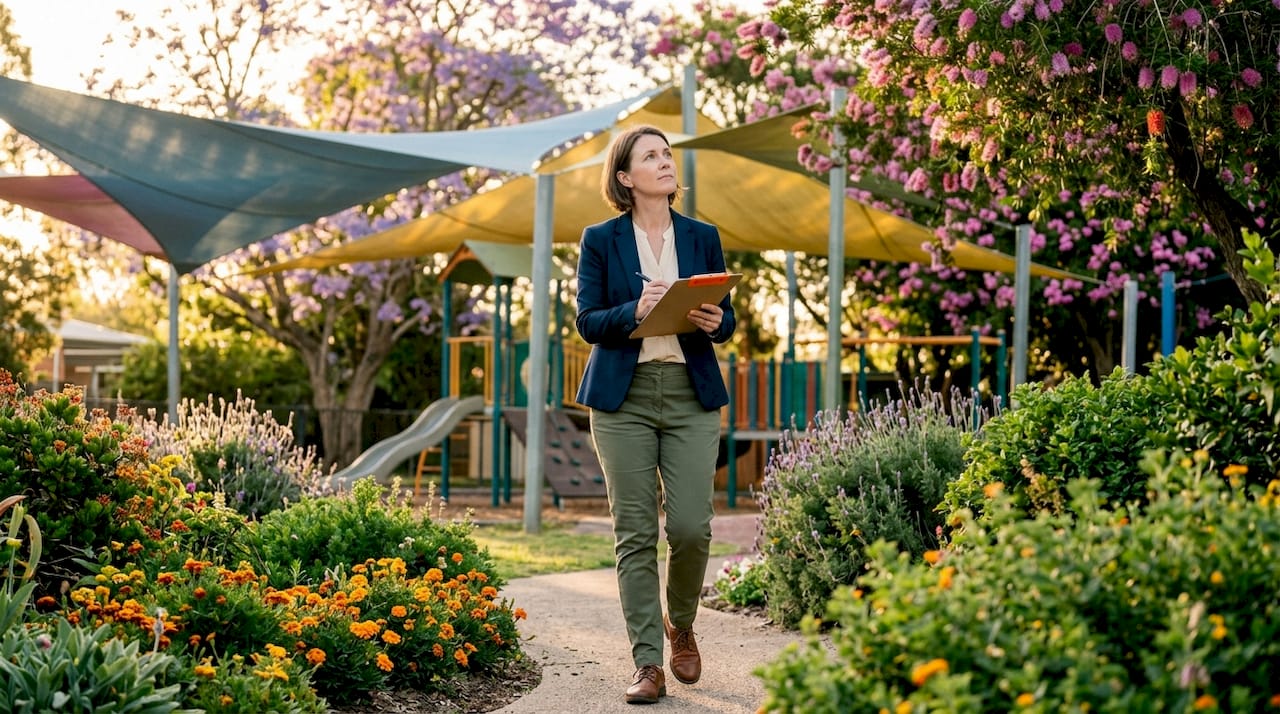
Effective shade is not uniform. UV-rated shade sails and well-placed tree canopies provide superior protection compared to standard playground equipment covers or open pergolas. A shade sail rated to block 95% or more of UV radiation delivers meaningfully different protection than a decorative canopy with no UV rating. Schools need to verify the UV rating of any shade structure before counting it as protective.
Auditing your school grounds
A UV risk assessment identifies which outdoor areas lack adequate shade and where students spend the most time. High-use zones like lunch areas, playgrounds, and sports fields should be prioritized for shade investment. School UV risk assessments align with occupational health and safety frameworks, giving schools a documented basis for infrastructure spending.
Tree planting is a long-term investment worth starting now. Mature trees provide broad, natural shade that no manufactured structure fully replicates. Schools in high UV regions that combine tree canopies with shade sails over key activity zones achieve the most consistent protection across the school day.
Pro Tip: Map your school grounds at solar noon on a clear day. Photograph shadow coverage across the playground, lunch area, and sports fields. The gaps you see are your priority zones for shade investment.
Scheduling outdoor activities before 10:00 AM or after 4:00 PM is a mandatory practice in high-performing sun-safe schools. This single scheduling change reduces UV exposure without any capital cost. For parents researching best shade solutions for young children in outdoor settings, the same principles that apply to school grounds apply to home yards and parks.
What role does education play in fostering sun-safe behaviors?
Education is what turns a policy into a habit. Rules tell students what to do. Education tells them why. Student understanding of the “why” behind sun safety increases compliance and builds long-term protective habits that extend beyond the school gate.
Effective sun safety education in schools includes:
- Curriculum integration: Sun safety fits naturally into health, science, and physical education classes. Teaching the UV index, the mechanics of skin damage, and the purpose of SPF ratings gives students practical knowledge they use for life.
- Age-appropriate messaging: Younger students respond to visual reminders like posters and classroom routines. Older students engage better with data, personal relevance, and peer-led initiatives.
- Parent communication: Newsletters, school apps, and parent meetings that explain the school’s sun safety program create alignment between school and home. Parents who understand the policy send children prepared.
- Student leadership: Peer influence is one of the strongest drivers of behavior in school-age children. Sun safety ambassador programs, where students lead reminders and model protective behaviors, produce measurable compliance improvements.
- Technology tools: Smartphone UV index apps enable schools and families to adjust protection protocols daily based on real conditions. Dynamic, daily UV checks make sun safety practical rather than theoretical.
The BANZ Protect app provides real-time UV monitoring, giving parents and educators an immediate read on daily UV levels. That kind of daily data makes sun safety a living practice rather than a once-a-year policy reminder.
How can schools implement and maintain sun-safe environments?
Creating sun safe schools requires a structured rollout, not a single announcement. The following steps give schools a practical path from intention to consistent practice.
- Conduct a UV risk assessment. Walk the school grounds and document shade coverage, high-use outdoor zones, and existing infrastructure. Identify gaps using the SunSmart audit framework from Cancer Council Australia.
- Draft a written sun protection policy. Include dress code requirements, sunscreen protocols, UV index thresholds for action, and outdoor scheduling guidelines. Involve staff, parents, and a school health advisor in the drafting process.
- Install sunscreen stations. Place dispensers with SPF 30+ sunscreen near outdoor exits. Integrating sunscreen into daily routines with accessible stations and timed reminders overcomes the inconsistent application seen in most schools.
- Train staff. Every teacher and aide needs to understand the policy, model protective behaviors, and know the UV index thresholds that trigger additional precautions. Annual training keeps knowledge current.
- Communicate with families. Send the policy home at the start of each school year. Include a checklist of what children need to bring daily: hat, sunscreen, and UV-protective clothing. A complete UV protection guide for parents supports this communication.
- Evaluate and update annually. Review compliance rates, shade coverage, and policy gaps each year. Update the policy based on new guidelines from the CDC or Cancer Council Australia.
Schools in high UV regions are more likely to have shade structures and uniform policies in place. Schools in lower UV areas often underestimate cumulative risk. Skin cancer risk builds from repeated, moderate exposure over years, not just from single high-intensity days. Every school, regardless of geography, needs a year-round sun protection program.
Key Takeaways
A sun-safe school environment requires written policy, physical shade, and active education working together, because no single measure protects students on its own.
| Point | Details |
|---|---|
| Written policy is the foundation | Document dress codes, sunscreen protocols, and UV index thresholds before anything else. |
| Shade quality varies significantly | UV-rated shade sails and tree canopies outperform standard playground covers with no UV rating. |
| Education drives long-term habits | Students who understand why sun safety matters comply more consistently and carry habits into adulthood. |
| Scheduling is a free tool | Moving outdoor activities outside 10:00 AM to 4:00 PM peak UV hours reduces exposure at no cost. |
| All schools carry cumulative risk | Low UV regions still accumulate skin damage over time; year-round programs are necessary everywhere. |
Why sun safety culture matters more than any single rule
I’ve spent years watching well-intentioned school health programs stall at the policy stage. The written document gets approved, filed, and forgotten. What actually changes behavior is culture, and culture is built by the adults in the room.
The schools that get this right do something counterintuitive. They stop treating sun safety as a compliance exercise and start treating it as a shared value. That shift shows up in small ways: a teacher who puts on a hat before stepping outside, a principal who mentions the UV index at morning assembly, a parent who packs sunscreen in the school bag without being asked. None of those actions require a policy update. They require adults who believe the risk is real.
The uncomfortable truth is that perceived UV risk drives enforcement. Schools in sunny climates take sun safety seriously because the threat feels immediate. Schools in cooler or cloudier regions often skip it because the risk feels abstract. But UV radiation penetrates cloud cover. Cumulative damage from years of moderate exposure is just as dangerous as a single severe sunburn. Every school, in every climate, owes its students a consistent program.
Technology helps close that perception gap. When a UV index app shows a reading of 7 on an overcast day in october, it makes the invisible visible. That data point changes decisions in a way that a policy document never will. Pair real-time UV data with engaged students and modeling adults, and you have a program that actually works.
— Shari M. Murphy
Sun safety tools and resources from BANZ
BANZ has supported over 2 million families across six continents with UPF 50+ sun protection gear designed specifically for children. Schools and parents looking to build or strengthen a sun protection program can access free guides, policy templates, and UV safety tools through the BANZ kids sun safety resource library, which draws on resources from the EPA, CDC, and WHO.
BANZ products, including UPF-rated hats and UV-protective clothing, directly support the dress code requirements that effective school sun safety policies mandate. For schools running fundraising programs tied to outdoor safety, the BANZ outdoor essentials fundraising page offers options that align sun protection with community engagement. Parents and educators can also explore UV safety resources for daily UV index guidance and child-specific protection tools.
FAQ
What is a sun-safe school environment?
A sun-safe school environment combines written sun protection policies, physical shade structures, and behavioral education to reduce students’ UV exposure during school hours. The SunSmart framework from Cancer Council Australia is the recognized international standard for this approach.
What UV index level requires protective action at school?
The CDC identifies a UV index of 3 or higher as the threshold requiring sun protection measures. A UV index of 8 or higher requires avoiding direct sunlight and increasing sunscreen reapplication frequency.
What sunscreen should schools use for children?
Schools should provide broad-spectrum SPF 30+ sunscreen applied 15–30 minutes before outdoor activity and reapplied every 2 hours. Mineral sunscreens are preferred for children with sensitive skin.
How do schools create effective shade for students?
UV-rated shade sails and mature tree canopies provide the strongest protection. Schools should conduct a UV risk assessment to identify high-use outdoor zones and prioritize those areas for shade installation.
How can parents support sun safety at school?
Parents can send children with a wide-brimmed hat, SPF 30+ sunscreen, and UPF-rated clothing daily. Engaging with the school’s sun protection policy and reinforcing sun safety habits at home strengthens the program’s effectiveness.
