

Act when the UV index hits 3 or higher: get your child into shade, add a UPF hat and clothing, and apply mineral sunscreen to any skin still exposed. Infants under 6 months belong in shade or clothing, not sunscreen, and kids on certain medications need extra caution even on cooler, cloudy days.
TL;DR:
- Most families should set a UV index alert at 3 to trigger protective actions like shade, clothing, and sunscreen before risk levels become high or very high.
- Reactions to UV alerts must be behavior-driven, such as putting on a hat or seeking shade, rather than just noticing a number or color on an app.
- Layered protection with UPF clothing and shade is more effective than relying solely on sunscreen, which should be applied early and reapplied every two hours.
- Infants under 6 months require shade and clothing protection and should only have sunscreen on small exposed areas if no shade is available.
- Combining real-time UV monitoring apps or devices with physical gear, like UPF hats and ear protection, creates an effective daily sun safety routine for families.
Table of Contents
- What the UV Index Means for Your Child’s Skin
- Which UV Alerts to Trust and What to Do When One Fires
- Layered Protection: What to Do When an Alert Warns of High UV
- UV Rules by Age: From Infants to Teens
- How the BANZ Protect App Fits Into Your Routine
- Real-Time UV Alert Apps and Devices Worth Using
- Teaching Kids to Recognize UV Risk Themselves
- Building UV Alerts Into Your Family’s Daily Routine
- Why Most Sun Safety Advice Gets the Order Wrong
- Gear Up: Shop BANZ Sun and Hearing Protection
- Sources
What the UV Index Means for Your Child’s Skin
The UV index (UVI) is a scale from 0 to 11+ that measures how strong the sun’s ultraviolet radiation is at a given place and time. It matters more for children than adults because young skin has less melanin and a thinner outer layer, so it burns faster and absorbs more UV damage per minute of exposure.
Here’s how the ranges break down in practice:
- 0 to 2 (low): Minimal risk. Sunglasses on bright days are still smart, but extended precautions aren’t necessary.
- 3 to 5 (moderate): Protection is recommended starting here. This is the threshold health authorities point to as the moment to act, not the moment risk begins.
- 6 to 7 (high): Shade and cover-up become priorities, not options.
- 8 and above (very high to extreme): Limit outdoor time entirely during midday hours.
Unprotected child skin can burn quickly at UVI 6, and less quickly but still within a short time frame at UVI 3. Those numbers shrink fast near water, sand, snow, or concrete, since reflective surfaces bounce additional UV back at your child even under an umbrella. And don’t let gray skies fool you: up to 80% of UV rays pass straight through cloud cover, so an overcast day at UVI 4 still calls for the same response as a sunny one.
Which UV Alerts to Trust and What to Do When One Fires
Not every UV app is built the same, and the gap between a good one and a mediocre one comes down to where the data originates and how the alert nudges you to act.
1. Start with the data source, not the app icon. NOAA and its affiliated meteorological services supply the raw UV forecasts that feed local weather reports and most reputable apps. If an app or widget can’t trace its numbers back to a source like this, treat its readings as a rough guess.
2. Use daily push alerts for planning, hourly watches for action. A morning UVI push tells you what kind of day it is. An hourly, location-aware watch tells you what’s happening right now outside your door, which matters more once you’re already at the park.
3. Set your threshold at UVI 3, not higher. Waiting for a “high” or “extreme” label means you’ve already missed the window where a hat and some shade would have been enough.
4. Tie the alert to a behavior, not just a notification. A reminder that fires 15 to 30 minutes before outdoor play, timed to when sunscreen needs to absorb, does more good than a passive daily number.
5. Know the three alert categories. Simple forecast widgets show today’s number. Activity-aware apps add sunscreen and reapplication reminders. Wearable-integrated tools sync UV data with a device you or your child already carries.
Pro Tip: Combine a location-based hourly alert with a separate reminder set 15 to 30 minutes before outdoor activity starts. The first tells you the risk; the second gets sunscreen on skin before you’re already out the door.
Layered Protection: What to Do When an Alert Warns of High UV
Think of sun protection like a checklist you run through in order, not a single product you grab on the way out. Clothing and shade come first; sunscreen fills in what’s left uncovered.
- Cover up first. UPF 50+ clothing, a wide-brim hat, and wraparound sunglasses block 99 to 100% of UV rays without needing reapplication.
- Choose broad-spectrum sunscreen, SPF 30 to 50+. Mineral formulas with zinc oxide or titanium dioxide tend to sit better on sensitive or eczema-prone skin than chemical filters.
- Apply early, reapply often. Sunscreen needs roughly 15 minutes to bind before sun exposure, and every 2 hours after that, sooner after swimming or heavy sweating.
- Read the water resistance label literally. “Water resistant (40 minutes)” means exactly that. It’s not a suggestion.
- Add extra vigilance near reflective surfaces. Water, sand, snow, and concrete all bounce UV back up at your child, so an umbrella on the beach is partial protection, not full coverage.
One overlooked risk: medication. Certain antibiotics and acne treatments can make skin far more sensitive to sunlight than usual. If your child takes a prescription medication and spends real time outdoors, ask your pharmacist or pediatrician whether photosensitivity is a concern before you rely on your usual routine.
UV Rules by Age: From Infants to Teens
Sun protection isn’t one-size-fits-all, and the right response to a UV alert changes as your child grows.
- Infants under 6 months. Keep them out of direct sunlight entirely, relying on shade, a stroller canopy, and lightweight clothing. Sunscreen should only touch small exposed areas, like the back of the hands, when no other shade option exists.
- Toddlers and preschoolers. You’re still the one applying sunscreen and dressing them in UPF swimwear. Build reapplication into your own routine since they won’t remind you.
- School-age kids. This is the age to teach alert-reading directly. Have them check the number themselves, build a habit around sunglasses, and reapply sunscreen at recess and after any water play.
- Teens. Tanning attitudes often work against sun safety at this age. Address medication use directly (acne treatments are common here), and encourage them to set their own alerts rather than relying on you to remind them.
How the BANZ Protect App Fits Into Your Routine
The BANZ Protect app gives parents real-time UV monitoring alongside noise-level alerts, built specifically around the fact that most families are juggling both concerns during the same outdoor outing. Set your threshold at UVI 3, turn on hourly forecast tracking for your location, and add a pre-activity sunscreen reminder timed 15 to 30 minutes ahead of when you actually head outside.
The app pairs naturally with the physical layer of protection. A UPF 50+ sun hat handles shade for the face and neck. UPF swimwear covers the torso at the pool. Combined earmuff and sunglasses sets add ear and eye protection for infants in loud, bright outdoor settings, like a family barbecue or a beach day with a crowd.
BANZ was built by a family that couldn’t find gear rated for the two things that actually put kids at risk outdoors: UV exposure and noise. That gap is still what the product line is designed to close.
Author Shari M. Murphy has covered children’s sun and hearing safety extensively, drawing on guidance from the American Academy of Pediatrics and National Weather Service throughout this reporting.
Real-Time UV Alert Apps and Devices Worth Using
The strongest UV alert tools share three traits: forecast data traceable to a real meteorological source, location awareness, and a reminder function that ties into your actual schedule rather than just displaying a number.
Simple forecast widgets, built into most weather apps, are the baseline. They show today’s peak UVI and little else. Fine for planning, weak for real-time decisions once you’re already outside.
Activity-aware apps go further by layering sunscreen reminders and hourly updates onto the same forecast data. An app that pairs location-based hourly UVI with a pre-activity reminder set 15 to 30 minutes before planned outdoor time closes the gap between knowing the risk and actually doing something about it, which is where most families fall short.
Wearable-integrated tools sync UV data to a smartwatch or fitness band, useful for older kids and teens who already check a wrist device throughout the day. For younger children, the practical setup is simpler: one parent-controlled app handling both the forecast and the reminders, rather than multiple tools competing for attention.
Whichever option you choose, the app itself is only half the system. It has to trigger an actual habit, hat on, sunscreen applied, before it’s doing its job.
Teaching Kids to Recognize UV Risk Themselves
A UV alert only works if someone acts on it, and by age 6 or 7, that someone can be your child. Teaching school-age kids to check a simple alert, a color code or a single number, and to carry a small tube of sunscreen builds a habit that outlasts your direct supervision.
Start with the color system before the numbers. Green means go outside freely, yellow means grab a hat, red means seek shade. Once that clicks, introduce the actual UVI number so they understand the yellow-to-red transition happens specifically at 3.
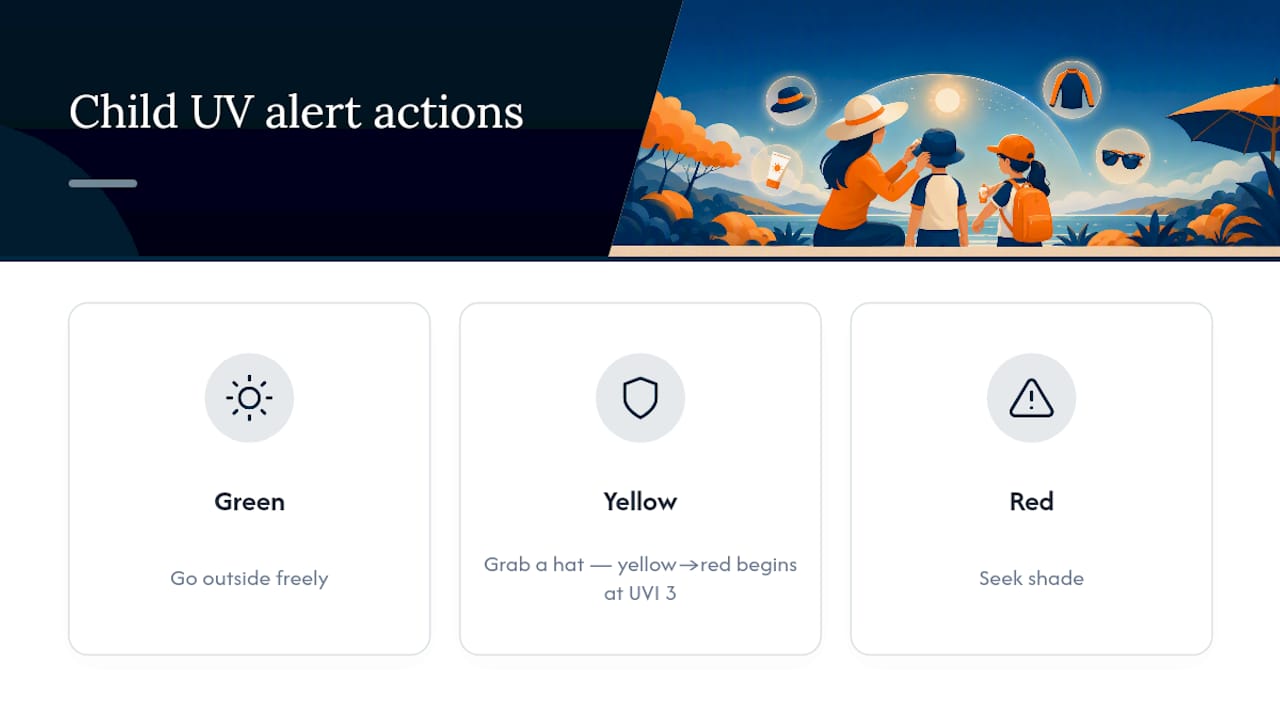
Make the connection concrete: show them how a shadow shrinks as the sun gets higher and UV climbs, since kids grasp visual cues faster than abstract numbers. Let them check the app themselves before a bike ride or a trip to the pool, and treat it the same way you’d treat checking for rain.
For teens, the conversation shifts. Tanning culture often works against sun safety messaging at this age, so frame it around performance and comfort (sunburn ruins a beach day, heat rash ruins a hike) rather than long-term risk alone, which feels distant to a 15 year old. Give them ownership of their own alert settings and their own sunscreen, rather than managing it for them.
Building UV Alerts Into Your Family’s Daily Routine
The families who actually stick with sun protection treat it as a planning input, the same way they’d check a rain forecast before deciding on an outdoor birthday party.
Start each morning with the daily UVI push. If it’s forecast at 3 or above, and it usually is between late spring and early fall in most of the country, that’s your cue to pack the hat, sunscreen, and sunglasses before you leave, not after you notice everyone’s turning pink.
For activities you control, like a park visit or a soccer practice, shift the timing when you can. Scheduling outdoor play before 10 a.m. or after 4 p.m. avoids peak UV hours entirely, which is often easier than trying to out-protect the strongest part of the day.
When timing isn’t flexible, like a scheduled swim lesson at noon, lean harder on the hourly watch and the pre-activity sunscreen reminder instead. Set the reminder to fire 20 minutes before you leave the house, giving sunscreen time to bind before anyone’s in direct sun.
Build reapplication checkpoints around natural breaks in the day: after lunch, after a swim, at the halfway point of a long outing. Tying it to something that already happens, rather than a standalone alarm, is what makes the routine survive past the first week.
Why Most Sun Safety Advice Gets the Order Wrong
Most sun safety content treats sunscreen as the star of the show and everything else as an afterthought. That’s backwards, and it’s a mistake I see repeated across parenting advice constantly. The research is consistent: clothing and shade are the primary defense, and sunscreen is what covers the gaps left over. Parents who lead with sunscreen tend to under-cover and over-trust a product that, even at SPF 50, still lets meaningful UV through and wears off faster than anyone expects.
The bigger gap, though, is alert fatigue disguised as awareness. Plenty of parents check a UV number without ever tying it to an action. A number on a screen changes nothing if it doesn’t trigger a hat going on or a reminder going off 20 minutes before playtime starts.
If you take one thing from this, prioritize the trigger over the tool. Set your threshold at 3, connect it to a specific behavior, and let the clothing and shade do the heavy lifting before sunscreen ever enters the picture.
— Shari M. Murphy
Gear Up: Shop BANZ Sun and Hearing Protection
BANZ gives you the physical side of a UV alert routine already built, so the reminder on your phone has something real to point to. Every product below fills a distinct role in a layered defense rather than duplicating what another one does.

- UPF 50+ Sun Hat with Pocket: Shade for the face, neck, and ears; the first layer to grab when an alert hits UVI 3.
- Hello Sunshine Sunhat with Sequins: A wide-brim option for kids who want style along with the shade.
- UPF 50+ Sun Hat with Toggle: Built for active kids who won’t sit still long enough for a chin strap.
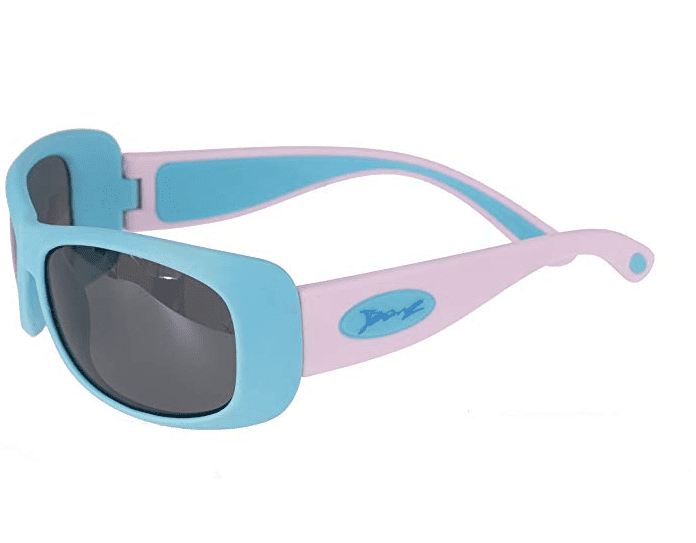
- Baby Earmuffs & Wraparound Sunglasses Combo: Eye and ear protection together for infants in loud, bright outdoor settings.
- Kids Hearing Protection Earmuffs: Pairs with any sun hat for older kids at fireworks, sports events, or noisy beach days.
For the full picture on setting alerts and layering protection by age, the BANZ UV safety resource library breaks down official EPA, CDC, and WHO guidance in one place. Pick your child’s size, set your UVI 3 alert, and build the routine around gear that’s already doing its job before the reminder even fires.
Sources
- Safeguarding Children — SKCIN
- Sun safety — Nemours KidsHealth
- Protect yourself, family and pets from excessive ultraviolet (UV) radiation — NWS
- NOAA